
Welcome to the eighth edition of FOI Clinical. Each week, I'll send you a briefing on outbreak news. When something urgent breaks, you'll get an alert the same day.
In this edition
Measles - Mumps - Haemophilus influenzae - Tularemia in CA - Tetanus in CA - Hepatitis A in Italy
National interest
Measles
As of March 27, 2026, there have been 1,575 cases, up 88 from last week. The largest case totals continue to be in South Carolina, Utah, Florida, and Texas.
The rate of new cases has dwindled, with the South Carolina outbreak effectively over, and the outbreak in Florida slowed. However, this is not the end of the measles resurgence. New clusters will likely emerge in the weeks and months ahead.
- South Carolina: 997 cases as of March 27. No new cases have been reported since the week of March 8.
- Utah: 29 new cases have been reported in the past week, raising this year's total to 318 (515 for the outbreak).
- Texas: Cases have increased by 23 in the past week, to 170. 87.1% of these cases are associated with federal detention facilities in the state, primarily within Hudspeth County (n=130, 76.5%).
- Florida: As of March 21, there have been 143 cases, an increase of 3 from the week prior.
Mumps
New mumps cases have been reported in California and Florida in recent weeks. In California, 5 cases have been reported since February 27, bringing the total this year to 9. In Florida, 3 cases have been reported since February 27, bringing the year-to-date total to 5.
Maryland's case total for the year has also increased to 35 (accounting for ~54% of all cases nationally so far this year). A typical year sees 350-450 mumps cases nationally.
Haemophilus influenzae
Florida and Ohio have together reported nearly 20% of all H. influenzae cases so far this year. There have been 114 cases reported in Florida, and 94 in Ohio. It is not clear what might be driving the relatively higher rates in these two states.
There are typically 3,000-6,000 invasive cases reported annually. Infection with H. influenzae bacteria can cause numerous types of infections, ranging from ear infections to pneumonia to bloodstream infection. It is spread via respiratory droplets.
Type B, one of 6 named types, is part of routine childhood vaccinations. Since vaccination was introduced in the 1980s, non-B and non-typeable H. influenzae have accounted for a growing proportion of invasive cases.
Regional interest
Tularemia in California
There has been one case of tularemia reported in California, according to the National Notifiable Disease Surveillance System. Additional details on the case are not available at this time.
For the past 40 years, there have been roughly 15o-300 cases reported each year in the United States. These have primarily occurred in the south-central United States, Pacific Northwest, and Massachusetts, but with locally-acquired cases reported in every state except Hawaii.
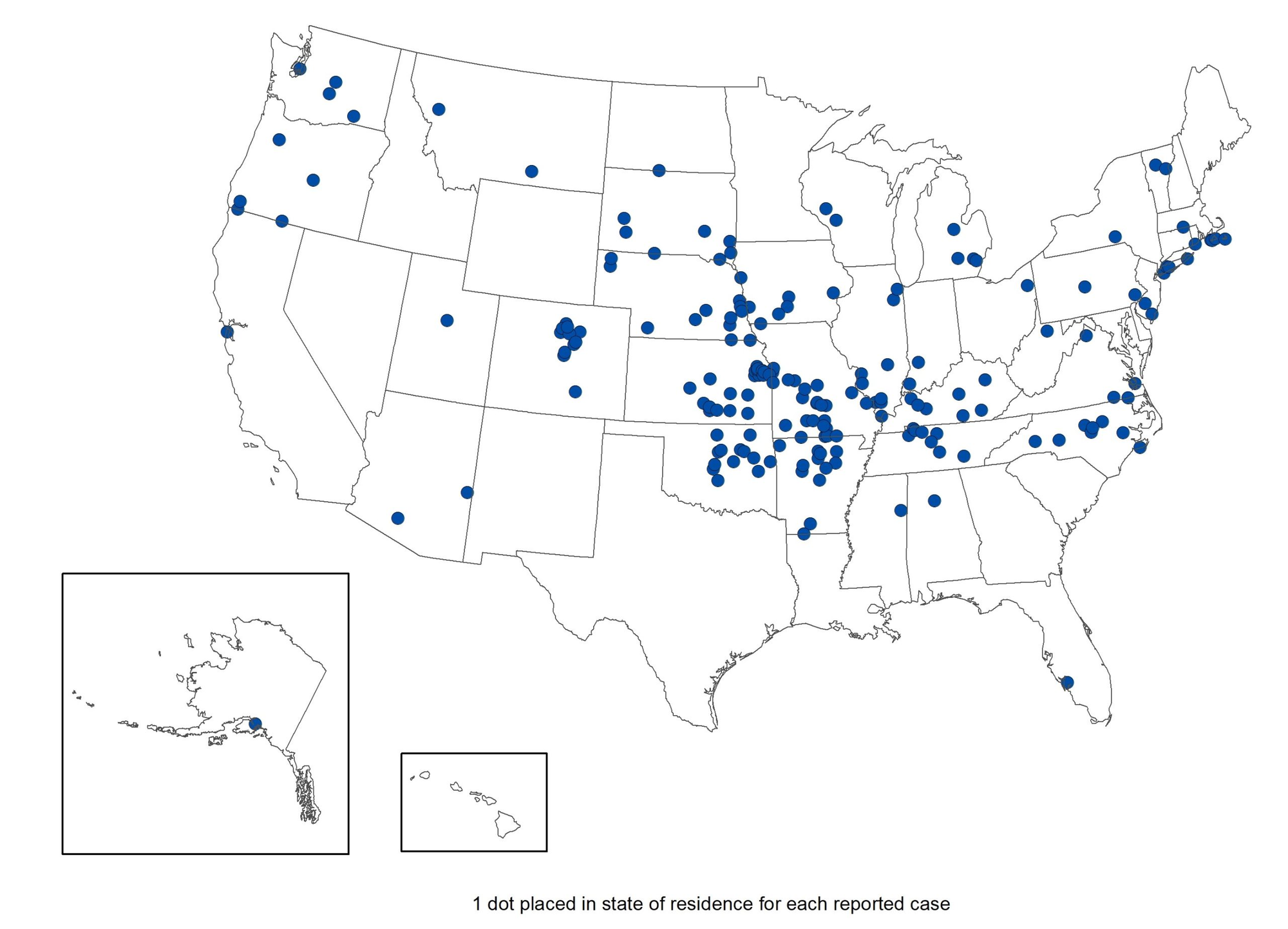
Tularemia is a bacterial infection (caused by Francisella tularensis). Humans can acquire the disease through various means, including bites from infected ticks or deer flies; handling or ingestion of infected animals (such as rabbits or rodents), or inhalation of dust or other aerosols contaminated with the bacteria (such as mowing over dead infected carcasses). It is also a recognized bioterrorism risk.
Illness can range from mild to life-threatening. There are several types of tularemia, based on the route of exposure. The most common type of tularemia is ulceroglandular, in which a skin ulcer appears at the site of contact, along with regional glandular swelling. It can be treated with antibiotics.
Tetanus in California
Last week, there was a tetanus case reported in California. There have been 4 total cases (2 in California and 2 in Florida) so far this year.
Tetanus is caused by toxins produced by spore-forming Clostridium tetani. Spores are found in feces-contaminated soil, and enter via breaks in the skin. Once germinated, a toxin is produced that affects the nervous system and causes severe muscle contractions.
Tetanus is not spread person-to-person. Diagnosis is based solely on clinical presentation; laboratory diagnostics are not available. It can be prevented via vaccination, and tetanus immune globulin is available for use prophylactically in wound management and for treatment.
There have been <40 cases reported each year in the US since 2010. Most cases in that time period have been in people who were never vaccinated, did not complete their primary vaccination series, or have not received regular 10-year booster shots. It has been fatal in roughly 5% cases in that time. Since tetanus vaccines were introduced into routine vaccination schedules in the 1940s, reported cases have decreased more than 95% and deaths have dropped more than 99%.
Tetanus cases have been increasing in the last few years; at the same time, vaccination rates have been declining. Coverage peaked at 95.2% of kindergarteners completing their DTP, DTaP or DT vaccination series in 2016-17 and 2017-18. As of 2024-2025, this has declined to 92.1% nationally, with 21 states reporting rates <90%. The 5 states with the lowest rates are Idaho (76.3%), Indiana (81.7%), Alaska (82.2%), Wisconsin (85.7%), and Kentucky (86.2%).
International interest
Hepatitis A in Italy
133 cases of Hepatitis A have been identified in the Campania region of Italy since the beginning of the year. In Naples, cases increased rapidly, with just 3 cases reported in January, 19 in February, and 43 from March 1-19. At least 54 individuals have been hospitalized, though they are reportedly not in critical condition.
Hepatitis A has fecal-oral transmission, spreading through person-to-person contact or through ingestion of contaminated food or water. It is readily transmitted through raw or undercooked foods, and is common in areas with inadequate sanitation.
Public health authorities have linked the increase in cases to ingestion of undercooked or raw contaminated bivalve mollusks (clams, mussels, and oysters). In response, there has been a temporary ban placed on serving raw seafood in all public establishments.
The incubation period for infection is usually about one month. As such, there are likely additional cases that have yet to be identified that were acquired before the recent public health measures were put in place.
The Campania region, which includes the Amalfi coast, draws a large number of international tourists. This is included here as a reminder as we enter the spring and summer travel seasons that Hepatitis A vaccine may be appropriate for travelers to many countries, including those in Southern and Eastern Europe.