
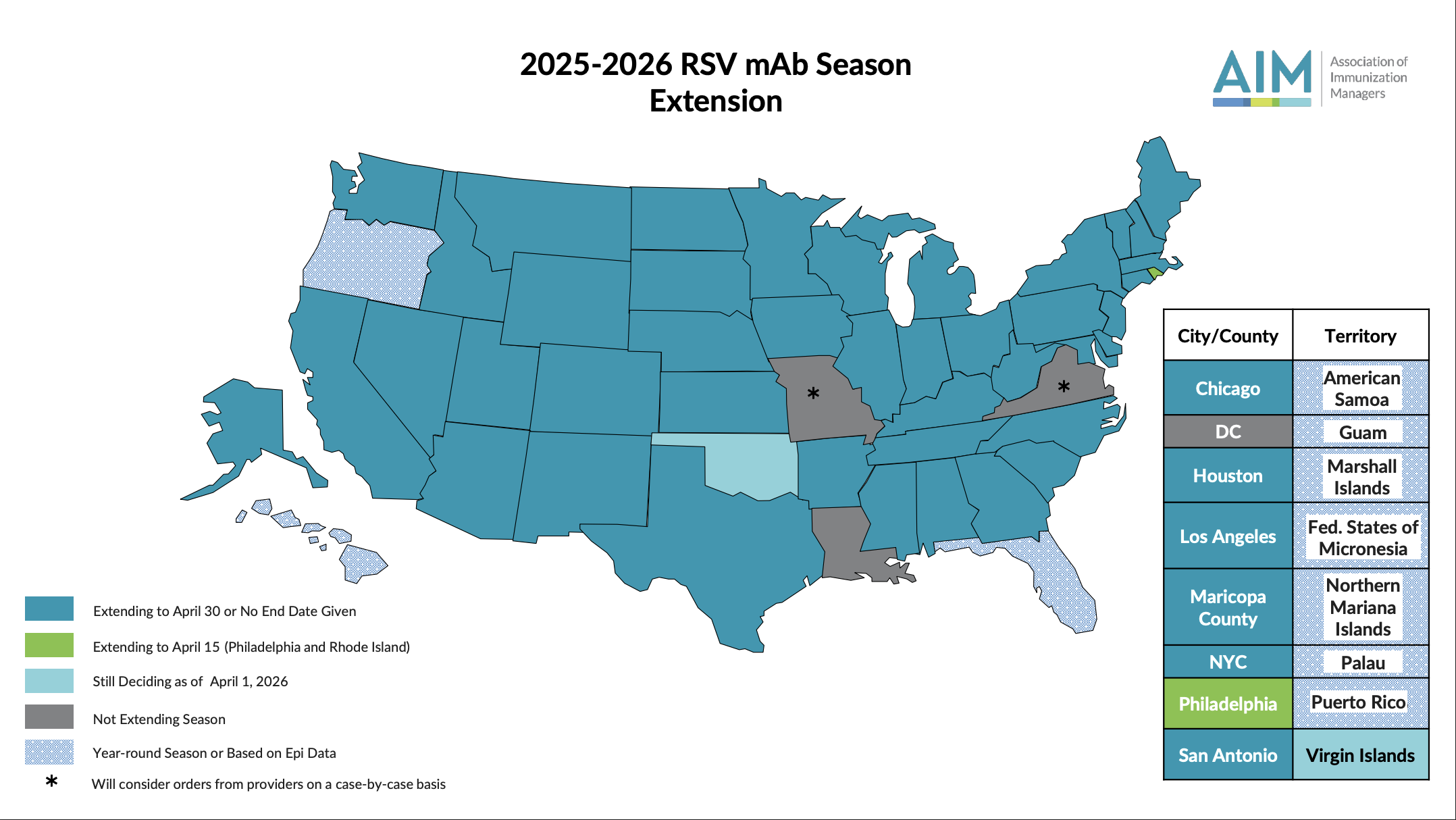
According to the Association of Immunization Managers, 48 of 66 jurisdictions are recommending that infants continue receiving RSV prophylaxis beyond the typical end-of-March cutoff, reflecting the prolonged RSV season this year. Most of these jurisdictions have set April 30, 2026 as the revised end date.
Current epidemiology
Nationally, emergency department (ED) visits for RSV have declined slightly to 0.4%, down from this season's peak of 0.6% in late February.
Regionally, the Midwest continues to see higher ED visit rates than the rest of the country (~0.7%), though all states in the region reported stable or declining activity this week. Pockets of elevated activity persist across all regions, including West Virginia, Vermont, and Wyoming.
Declines are more pronounced in the pediatric age groups most affected by RSV: ED visit rates for infants (<1 year) and children aged 1–4 years have dropped to 3.4% and 2.7%, respectively.
Hospitalizations, a lagging indicator, remain high at 2.2 per 100,000 but have declined from a peak of 3.0 per 100,000 in late February. Rates in young children remain substantially elevated despite recent declines: 20.4 per 100,000 in infants (<1 year) and 7.4 per 100,000 in children aged 1–4 years.
Immunization coverage
According to data from CDC, the 2025–26 season has seen the highest RSV immunization coverage on record. As of February, 65.1% of eligible infants had some form of RSV protection: 55.7% through nirsevimab and an additional 9.4% through maternal vaccination. Coverage among pregnant women has also been increasing in recent years. As of January 31, 40.3% of those at 32 or more weeks gestation had received Abrysvo.
Adult vaccination rates, while more modest, reflect continued uptake among older age groups, with 43.2% of adults 75 and older and 32.8% of those aged 50–74 having received an RSV vaccine as of late February.
Clinical Information
The American Academy of Pediatrics published recommendations for infants and children in October 2025. Briefly, the AAP recommends RSV immunization for all infants under 8 months entering their first RSV season, unless the pregnant parent received RSVpreF vaccine at least 14 days before delivery. For the second RSV season, immunization is recommended for children 8–19 months who meet high-risk criteria, including chronic lung disease of prematurity, severe immunocompromise, cystic fibrosis with severe manifestations, or American Indian or Alaska Native heritage.