
Welcome to the twenty-third edition of FOI Clinical. Each week, we'll send you a briefing on outbreak news. When something urgent breaks, you'll get an alert the same day.
In this edition
Cyclosporiasis – Measles – West Nile virus – E. coli: Publix blueberries – Infant botulism update – Legionnaires': New York City – Salmonella: Shinnecock Nation – Chagas disease: California – Ebola – Marburg
National interest
Cyclosporiasis: largest U.S. outbreak on record
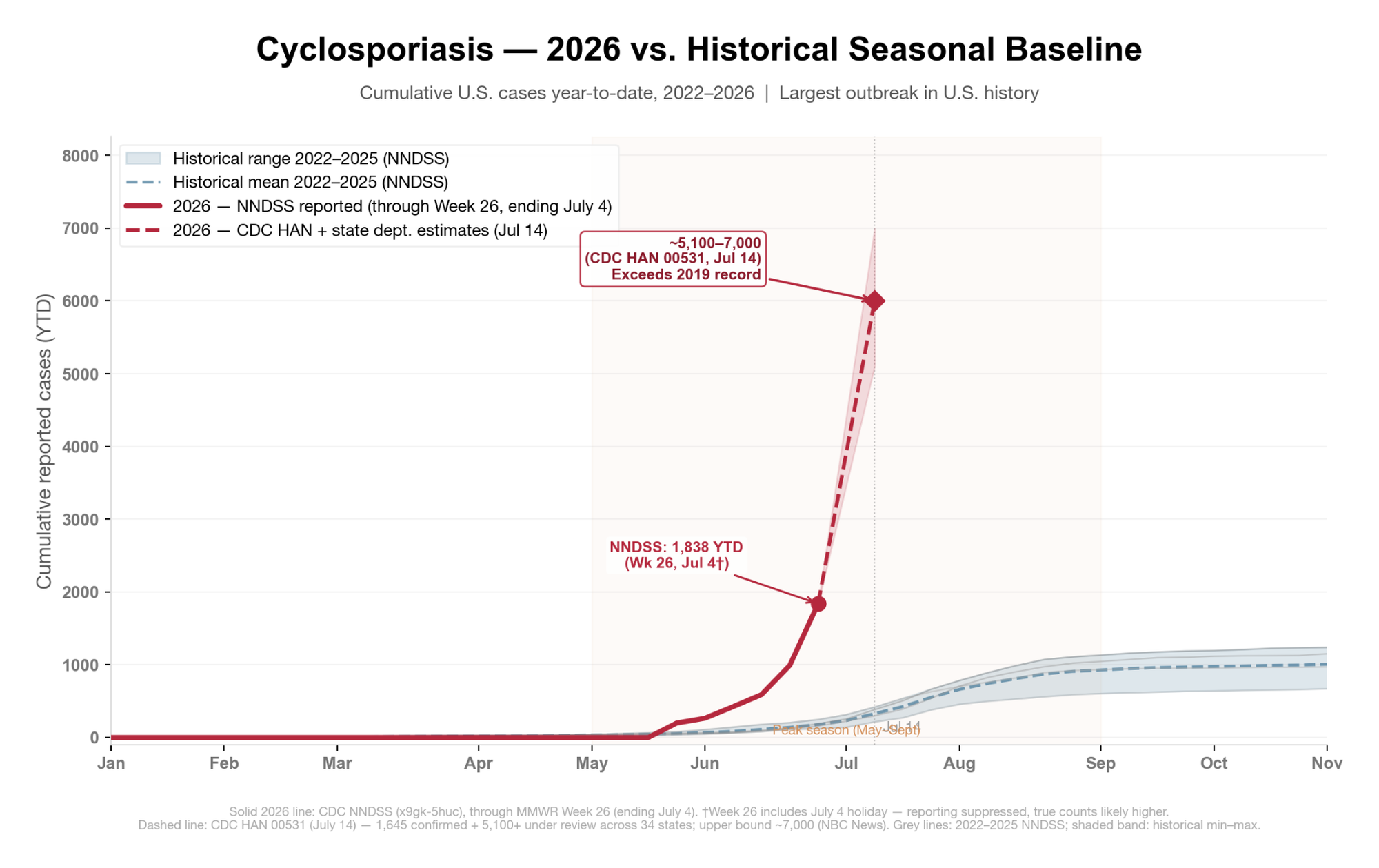
On July 14, the Centers for Disease Control and Prevention issued a Health Alert (CDC HAN 00531) with data suggesting 2026 could become the largest cyclosporiasis year on record, surpassing 2019's peak of approximately 4,700 cases.
As of July 14, there have been 1,645 confirmed cases across 34 states, plus 5,100+ additional cases under review, approaching 7,000 when combined. To date, there have been at least 141 hospitalizations (9%) and zero deaths.
Data from the Nationally Notifiable Disease Surveillance System shows 358 cases reported in the most recent week, with a year-to-date cumulative total of 1,838. The four-week trajectory confirms rapid acceleration, rising from 64 to 73, then jumping to 180 and 358. The full state-level burden is substantially higher; Michigan alone reported 700 cases on July 1, climbing to 3,762 by July 15.
Michigan (3,762 cases across 56 counties; 44 hospitalizations as of July 9) leads with the most cases. Michigan, as well as Ohio (397, 57 counties), West Virginia (statewide outbreak declared, 47 cases reported), and Kentucky (~100 cases) share a confirmed epidemiological link per the CDC's health alert. New York (517 statewide), North Carolina (307), and Illinois (216) are also among the states reporting elevated counts.
No food source has been confirmed and no recall has been issued. However, Michigan officials have named lettuce and salad greens as the leading hypothesis, following more than 1,000 patient interviews. Two epidemic curve peaks have been detected (~June 25 and ~July 7), suggesting possible multiple contamination sources or lots. Taco Bell voluntarily pulled select items (lettuce, cilantro, onion, pico de gallo, guacamole) in some locations; CDC and FDA have not confirmed a link.
Measles
Measles cases are outpacing 2025 levels. CDC updated this year's total to 2,231 confirmed cases as of July 9, just 58 cases short of the 2025 full-year total (2,289) with five months remaining.
State updates:
- Virginia: 177 cases, with no new cases reported since July 4. 169 of 177 cases are in unvaccinated individuals; 9 hospitalized, no deaths. Buckingham County (126), Cumberland County (17), and Prince Edward County (11) account for the core outbreak; additional cases are distributed across other localities.
- Iowa: First 2026 case added, in a Polk County adult.
West Nile virus
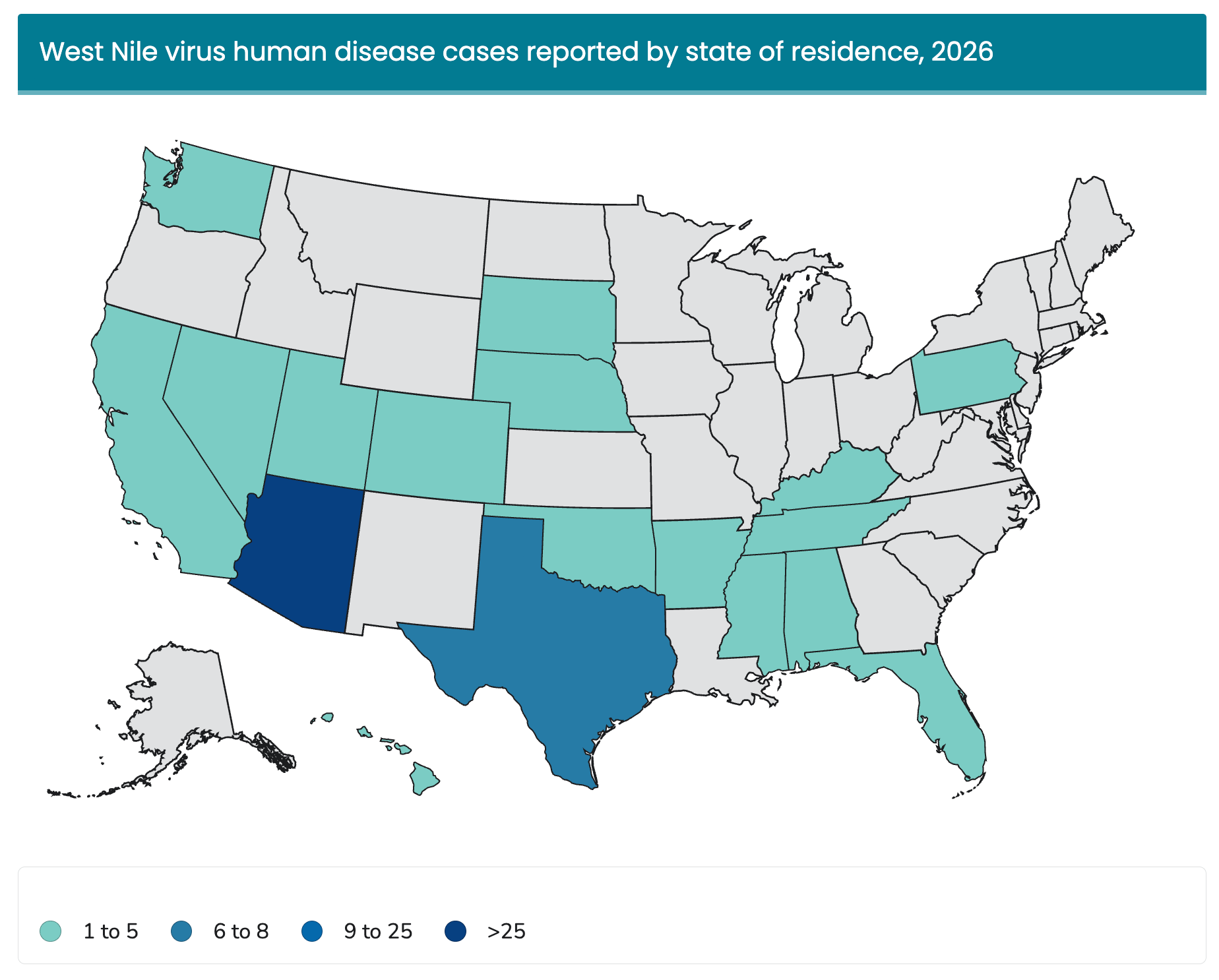
2026 has the worst early-season start in more than 20 years. As of July 14, 81 confirmed human cases were reported across 18 states, with 57 (70%) neuroinvasive.
Maricopa County, Arizona, accounts for 50 cases, or about 62% of the national total. The national count is already five times the historical average for this point in the season, according to a recent update from CDC. Peak WNV activity (August–September) has not yet arrived, which means case counts will continue to climb for several more months.
E. coli: Publix frozen blueberries
An E. coli O145:H28 outbreak linked to GreenWise Organic IQF Blueberries (10 oz, lot 60401, best by Feb 9, 2028) has caused 12 cases, mostly in Florida (11) but also Georgia (1). To date, there have been 4 hospitalizations and no deaths. The FDA issued a recall on July 3. The product was sold at Publix in AL, FL, GA, KY, NC, SC, TN, and VA. Clinicians in affected regions should inquire about frozen blueberry consumption in patients presenting with bloody diarrhea.
E. coli O145:H28 is a Shiga toxin-producing strain (STEC) that causes hemorrhagic colitis and carries risk for hemolytic uremic syndrome (HUS). Serotype O145 is less frequently encountered compared to O157:H7. The pathogen typically enters the food supply through contaminated produce. Incubation period is generally 3–4 days. Clinical presentation includes watery diarrhea progressing to bloody diarrhea, abdominal cramps, and occasionally fever. More information is available from CDC.
Regional interest
Infant botulism: Nara Organics, fourth case
The multistate infant botulism cluster linked to Nara Organics Whole Milk Organic Powdered Infant Formula has added a fourth confirmed case, up from three at last report. All four cases involve toxin type A. The product remains recalled; laboratory testing of product samples is ongoing. All four cases were hospitalized, and no deaths were reported.
As described in Issue 21, this is the second product-associated infant botulism outbreak within eight months. Confirmation from product testing is still pending.
Legionnaires' disease: New York City
The Upper East Side Legionnaires' cluster described in Issue 22 has reached 63 confirmed cases (Carnegie Hill/Yorkville, ZIP codes 10028, 10075, 10128) as of July 14, with 12 people currently hospitalized and no deaths. The new case rate appears to be slowing as of July 15 data.
The NYC Department of Health and Mental Hygiene has ordered remediation of 31 buildings (per official source; media reports cite an updated count of 76) with PCR-positive cooling towers, including the Solomon R. Guggenheim Museum and the Metropolitan Museum of Art. A separate Legionella detection occurred in an Upper West Side building's hot water system (July 11).
The source is still unconfirmed and genomic sequencing of environmental isolates is underway, with an expected 2-week turnaround. PCR identifies the presence of Legionella DNA (live and dead); it cannot confirm the source without culture match.
Standard empirical community-acquired pneumonia regimens do not always include coverage for Legionella; urinary antigen or respiratory PCR should be requested in compatible presentations from these ZIP codes. Clinical cultures require specialized media and must be specifically requested.
Salmonella: Shinnecock Nation, Long Island
A suspected salmonellosis outbreak has caused 58 hospital presentations at Stony Brook Southampton Hospital in Suffolk County since July 1, linked to funeral services held June 30 within the Shinnecock Nation community on Long Island's East End. The Shinnecock Nation issued a statement July 13; Suffolk County health officials have characterized this as an isolated point-source outbreak. There have been no fatalities. The investigation is ongoing, and the pathogen has not yet been publicly confirmed. Most patients have been treated and discharged.
Chagas disease: California
San Diego health officials reported a locally-acquired case of Chagas disease earlier this month. The infection was detected during screening of donated blood. Chagas disease is not considered endemic in the United States, but autochthonous cases have been identified in at least eight states, despite suspected underreporting.
Chagas disease is caused by the parasite Trypanosoma cruzi and is primarily transmitted through the feces of infected triatomine bugs (kissing bugs). The parasite enters the body when bug feces contact a bite wound, eyes, or mouth—infection does not occur from the bite itself. Chagas has two phases: acute infection, typically occurring in the first weeks to months with mild or absent symptoms (including fever, fatigue, body aches, rash, and occasionally eyelid swelling), and chronic infection, which can last years or a lifetime. Most people with chronic Chagas remain asymptomatic, but approximately 20 to 30% develop serious complications including cardiac disease or GI disease. Treatment consists of antiparasitic medications to kill the parasite plus supportive care to manage symptoms. Chagas can also be transmitted congenitally, through blood transfusion, organ transplant, or consumption of contaminated food.
International interest
Ebola: 2,000 cases. Second American evacuated, CDC notice updated
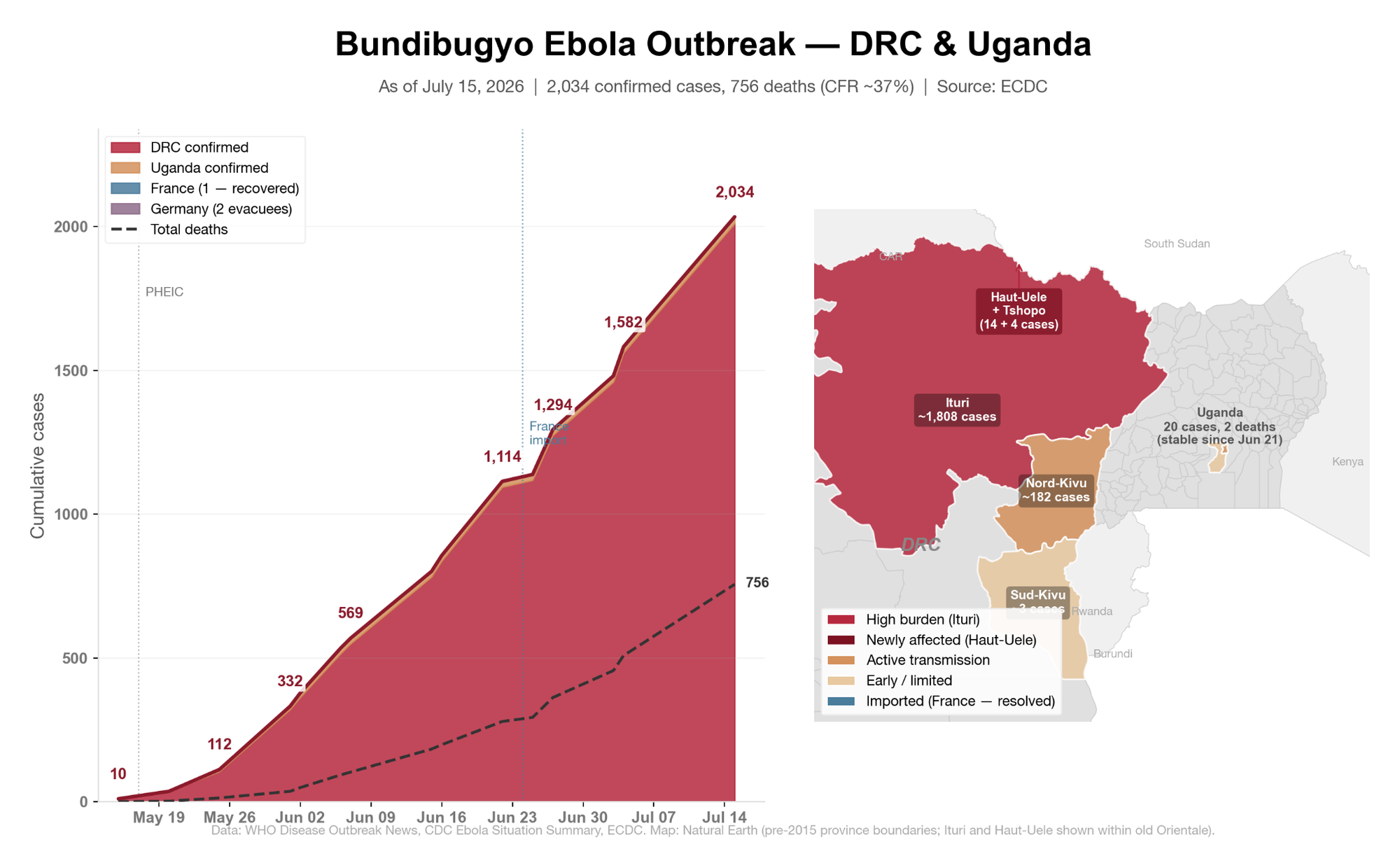
The Bundibugyo outbreak has reached 2,011 confirmed cases and 754 deaths in DRC (case fatality ratio of ~37%), with Uganda stable at 20 cases and 2 deaths. There have been an additional 450 cases and 248 deaths recorded in the 11 days since July 4. Approximately 92% of investigated deaths occurred in the community or before reaching a facility, which suggests that case ascertainment is poor.
DRC now has 5 active provinces spanning 45 of 140 health zones: Ituri (1,808 cases, 26 health zones; dominant), North Kivu (182), Haut-Uélé (14; CFR 93%), Tshopo (4; new this week), South Kivu (3).
Second American evacuated: A Samaritan's Purse logistics worker based at the Bunia treatment center tested positive July 10 and was medically evacuated to Frankfurt, Germany on July 13. Germany now has two total evacuee cases and zero deaths.
CDC updated its Level 3 travel notice to include Haut-Uélé and Tshopo (previously flagged in FOI Clinical as a gap). There are reports of a forthcoming restriction on U.S. entry for travelers recently in DRC and certain travelers from Uganda and South Sudan. Returning travelers will be required to spend 21 days in a third country. This is likely to be challenged in court. Separately, CDC Level 1 emergency operations center remains active. Airport screening continues at IAD, ATL, IAH, and JFK.
The PARTNERS treatment trial (MBP134 + remdesivir) is ongoing in Bunia (~2 weeks in, target 700–1,000 participants). No interim results yet.
Marburg virus: Uganda
Uganda's single confirmed Marburg case (a 1.5-year-old child in Kyegegwa District who died) has produced zero secondary cases as of July 9. The 42-day countdown to end-of-outbreak declaration runs to approximately August 10–12, assuming no new cases. The U.S. Embassy Level 4 health alert for Uganda remains in effect. No WHO end-of-outbreak announcement has been issued.
FOI Clinical is published weekly. For questions or feedback, contact [email protected].