Welcome to the thirty-fifth edition of FOI Clinical. Each week, we'll send you a briefing on outbreak news. When something urgent breaks, you'll get an alert the same day.
In this edition
Measles: Pennsylvania passes 1,000, New York declares an emergency – Influenza: CDC says activity is increasing – Cyclosporiasis: FDA closes with a finding – Mumps: San Diego State reaches 15 – National surveillance, week 38 – Vibrio vulnificus: Florida – Dengue: Florida passes 250 – Cryptosporidiosis: a hotel pool in Washington – Russia: a death at a plague institute – Ebola: an imported death in Kenya
National interest
Measles: Pennsylvania passes 1,000 cases and records a fifth death
On September 30, the Pennsylvania health department confirmed a fifth measles-associated death in an unvaccinated resident of Lancaster County. The department said it reported the death to CDC and would not release identifying details.
CDC's national count, updated October 2, still lists two measles deaths in 2026. The mechanism behind the discrepancy is the one we have described since Issue 32: CDC draws its figure from National Center for Health Statistics death records instead of state reports, and those records are filed and coded over months.
State updates:
Pennsylvania: the state dashboard read 1,078 cases on October 7, including 145 in the preceding seven days. To date, 207 people have been hospitalized, just under a fifth of all cases, and fewer than 1% of cases were in people recorded as fully vaccinated. The health department's September 30 news release reports that providers, who typically give about 25,000 MMR doses a month, gave more than 49,000 in August and more than 53,000 in September; state health center staff have given more than 5,500 doses at 180 pop-up clinics since the outbreak began in late April. Increased immunization coverage is important for slowing the spread of the months-long outbreak; September saw the most cases so far this year.
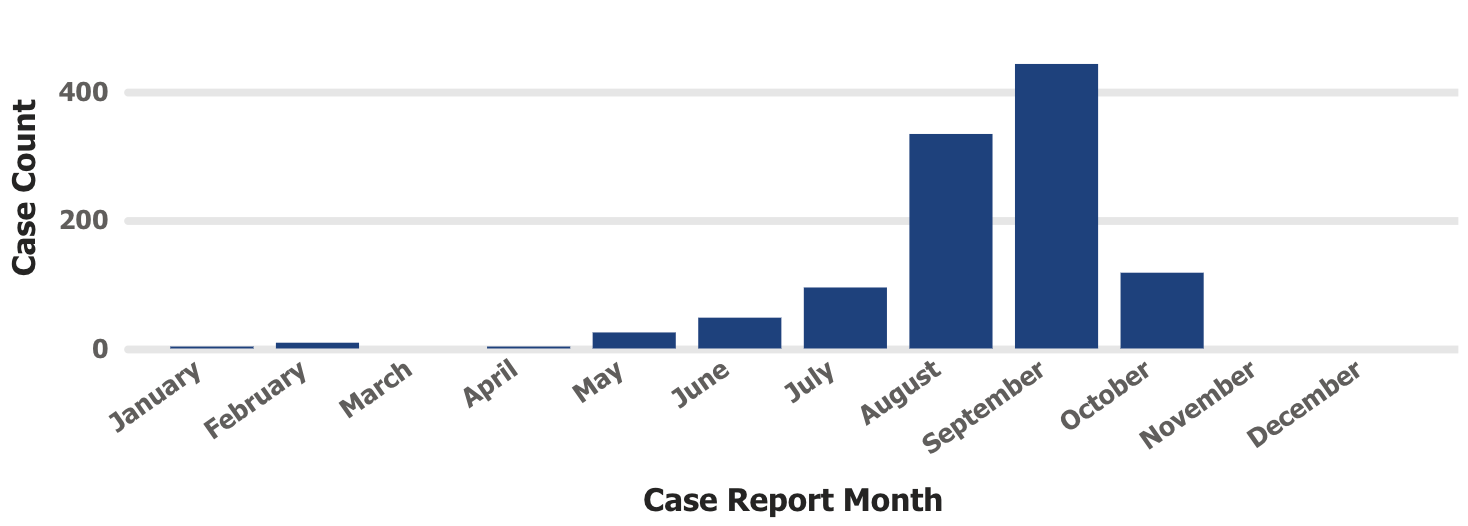
- Wisconsin: state health services confirmed 258 cases statewide on October 6, up from 214 a week earlier. The southwest outbreak in Grant, Iowa, Lafayette and Vernon counties accounts for 234 confirmed and six probable. Marathon County has five cases and Chippewa 11, both of which the department attributes to out-of-state travel.
- New York: Governor Hochul declared a state disaster emergency on October 5 in response to an increasing number of cases in the state and in neighboring Pennsylvania. The executive order lets paramedics, advanced EMS providers, pharmacists and midwives administer measles vaccines, and allows nurses as well as physicians to order testing. The state reports 108 cases this year as of October 3, seven in New York City and 101 elsewhere in the state. Ninety-two have been reported since July 15, among under-immunized, rural communities in 18 counties, and local health departments have given more than 1,000 MMR doses across rural areas since then.
Influenza: CDC now says activity is increasing
CDC updated its assessment to recognize early-season flu activity. Where FluView for week 37 opened with "seasonal influenza activity is low," week 38, published October 2, reads "seasonal influenza activity remains low nationally, but is increasing."
Clinical laboratory test positivity rose to 3.4%, from 2.7% the week before; 1,151 positives from 33,547 specimens, 96% of them influenza A. Outpatient visits for influenza-like illness (ILI) were 1.7% nationwide, which is below the 3.1% baseline that marks the start of a flu season, so by the outpatient measure the season has not started, even as test positivity climbs. Outpatient ILI is highest in children under five, at 5.5%, up from a recent low of 3.2%.
The regional picture reveals increased activity in many Western states. Our Outbreak Outlook for October 4 puts HHS Region 9 (which includes California, Arizona, Hawaii and Nevada) at 7.1% test positivity, up from 3.4% two weeks earlier. Region 10, covering Alaska, Idaho, Oregon and Washington, is at 6.0%, slightly down from 6.5% the week before. Both regions show low but rapidly increasing emergency department visits for influenza, particularly in children.
Of 55 specimens subtyped at public health laboratories in week 38, 53 (96.4%) were A(H1N1)pdm09 and just two were H3N2. Last year, H3N2 predominated. The weekly numbers are still too small to call a change in dominant subtype, but the direction has now been consistent for two weeks.